


It was a cold, rainy, near-icy day in January 2008 when I drove down to Morgan City to visit Mom and Dad. My dad, who had been working since he was 15 and now at age 70, was consulting with investors and companies. They were talking about how to recycle oilfield platforms, refurbish and reuse them for new setting and production far offshore. As the owner of his own company for over 10 years and very financially successful, when one of his “projects” was ready for deployment offshore, Dad didn’t trust the final transport and setting of those platforms to anyone but himself. So even at 70 years old, he was offshore in this wintry weather making sure everything went well. I knew he was due back that day, and I went down to meet him.
“That’s the LAST time I’ll ever go out and do that!” he told me a few hours later. The industry he had worked in for decades had changed. Gone were the deep-pocketed, safety-conscious oil companies that hired his company in the past. They were replaced by anonymous investors/operators who seemed to focus more on profit rather than regulation. He felt that he was no longer safe doing what he loved and was facing, finally, actual retirement.
“I’m concerned, I’ll be honest with you. I mean, this is the biggest change imaginable, and I always worry if we’ve saved enough. Will I know what to do with myself when I don’t have to get up and go to work every day? I’m nervous about it all, but I know I can’t keep going.”
“I get that, but isn’t it about time to go fishing, hunting and traveling again?” I suggested. “Change is scary for everyone, but you have all the tools to deal with it, so I’m not worried about you taking a step back. I’m sure Mom will appreciate it, too!”
It was not lost on me that the bravest, strongest, most competent man I’d ever known, who had the guts and temerity to raise ME (talk about a battle!), was afraid of change. I guess that means at times, we all can be scared when facing big changes.
Louisiana, we are now facing some significant financial changes in the ACA individual insurance market with the expiration of enhanced financial aid that’s been in place since 2021. And while we can’t all just go fishing, we all need to know what’s coming so that we can adjust.
So Mike, how is HealthCare.gov going to work without Advanced Premium Tax Credits (subsidies)?
Let’s get one thing clear up front: There are still BILLIONS in subsidy help available for folks to buy health insurance on HealthCare.gov. The income levels to qualify are just going back to what they were in the original ACA. That’s the levels that were in effect when HealthCare.gov launched for 2014 health plans.
What changed, when and why?
In 2021, Congress was concerned that COVID-19 disruptions were causing a lot of people to go uninsured (lack of employment, drastic income variations from shutdowns, etc.) They decided to make it much easier to qualify for even more lucrative lucrative HealthCare.gov tax credits. That meant people who made A LOT more money could now get the tax credits, and MANY more lower-income folks could find insurance for $0 per month. This change poured about $35 billion a year into the HealthCare.gov exchanges nationwide, and Louisiana customers were the beneficiaries of about $1 billion of that.
The new spending was a combination of richer financial aid AND millions of new people who previously got insurance somewhere else (like through an employer) moving to HealthCare.gov and individual coverage so they could take advantage of the enhanced subsidies.
The original act (ARPA) that passed in 2021 only funded this enhancement and new HealthCare.gov money for more people through Dec. 31, 2025. After a bit of debate throughout the latter part of 2025, Congress chose to not extend that extra subsidy funding. That means the enhanced subsidies expire as planned in the original legislation on Dec. 31, 2025.
While it’s possible Congress will do something about the enhanced subsidies and extend them in some form during their 2026 session, it’s not guaranteed. And we have to act on what we know. So, from Dec. 31, 2025, forward, and for HealthCare.gov plans that start coverage on Jan. 1, 2026, we are back to the levels of financial assistance in place with the original law. Back to the future, if you will.
OK then, what does that actually mean to people in Louisiana?
To be clear, these changes will mostly affect the 300,000 or so Louisianians who buy individual coverage through HealthCare.gov, the vast majority of whom receive some level of financial help to pay their premiums. That’s about 6.5% of the people in Louisiana.
Initially, two major changes will result because of the enhanced subsidies expiring:
- Originally, ACA tax credits were available to people whose income was up to 400% of the Federal Poverty Level. The 2021 enhanced tax credits took that 400% cap off and replaced it with a simple statement: You are responsible for a maximum of 8.5% of your household income in premiums. Every dollar of premium above that will be paid by the federal government.** For 2026 and beyond, the 400% cap is back. This means a single person who makes more than $62,600 a year will no longer be eligible for financial aid to pay for their health plan. For a family of 4, the 400% cap applies if they’re making more than $128,600 per year.
- The range of health plans available at $0 premium to lower-income folks (those earning 200% of the Federal Poverty Level and below) shrank pretty dramatically. In some markets, the number of plans available at $0 was cut in half or worse for the average buyer. Thus, more people will have to pay a premium to keep their plan at the same level of coverage they had, or move to a plan with a smaller network of medical providers, or higher cost sharing, or both.
The premiums for many HealthCare.gov plans also went up at a much faster rate than in any other year so far. Why? Because of some expected downstream effects of these changes that will drive up costs.
Many people were purchasing a HealthCare.gov plan at $0 premium but not actually using their insurance benefits because they had no major health issues. Now, faced with an actual out-of-pocket premium they’ll have to pay for a plan with services they weren’t using, we expect many of those folks will drop coverage. This means the overall pool of people who are insured will on average end up being LESS healthy than the risk pool of the past four or five years. Since the people remaining will be using more care on average, spending on healthcare (and therefore health insurance rates) will be higher across the board. Average increases for 2026 in the 20%-plus range are very common.
This means that several changes in the Louisiana health insurance market are likely:
- Dependents and spouses previously covered on employer plans who moved to the individual market to use the enhanced tax credits will now have to re-evaluate that decision. For comparison, group coverage rate increases ran lower than individual plan rates but were still significant at 8-9% increases on average.
- People who had a $0 premium plan and no longer qualify for the same financial aid in 2026 will have to decide whether to pay a new premium, change plans or (hopefully not) drop coverage completely.
- Small companies or sole proprietors who found the individual market tax credits more to their liking since 2021 may well find the small group market is their least-expensive option again, as it was in the past. This may also lead to more people who had been on HealthCare.gov plans migrating back to employer coverage.
The Straight Talk is, change is upon us and it is scary, as usual. Our job here is to help you fight back against that fear with information and options. That’s what Straight Talk is all about.
Connect With an Agent for Help Understanding Your Options
Amid trying to understand all these changes, I can’t stress enough that you don’t have to go it alone. You can get help from a licensed, experienced agent familiar with HealthCare.gov plans. An agent will compare your health plan options, help you calculate how much financial aid you could qualify for and show you how to enroll for 2026 coverage. It does not cost anything to work with an agent, and there is no obligation to buy or enroll in a health plan because you speak to one. That makes this a no-risk, high-value option that I strongly encourage you to take advantage of.
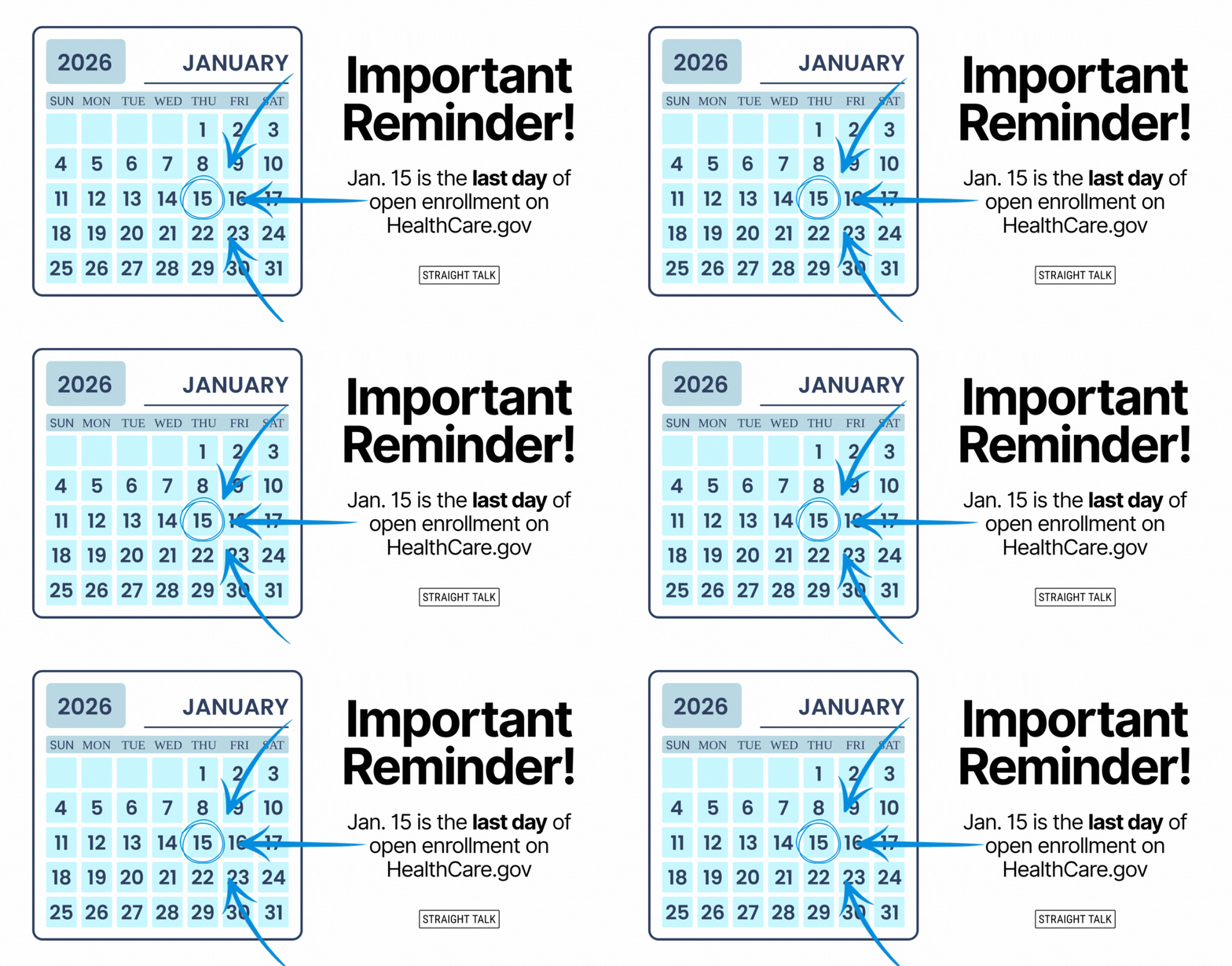
Connect with an agent by calling 1-844-GET-BLUE or visiting lablue.com. HealthCare.gov enrollment goes until Jan. 15, 2026, for coverage that will take effect Feb. 1.
If you’ve been putting off choosing your 2026 health plan to see what happens in D.C., it’s time to get in touch with an agent and explore your options. After the Jan. 15 enrollment end date, enrolling in individual ACA plans becomes much more difficult. And, you don’t want to risk going uninsured and having to pay all your healthcare expenses out of pocket.
**Assumes purchase of a benchmark Exchange Plan, i.e., the second-cheapest Silver plan in a ZIP code.



Great information as always Mike.